Leverage kills quietly. See the number
At 20× leverage, a move of about 4.5% against you loses the whole margin you posted.
The number that matters
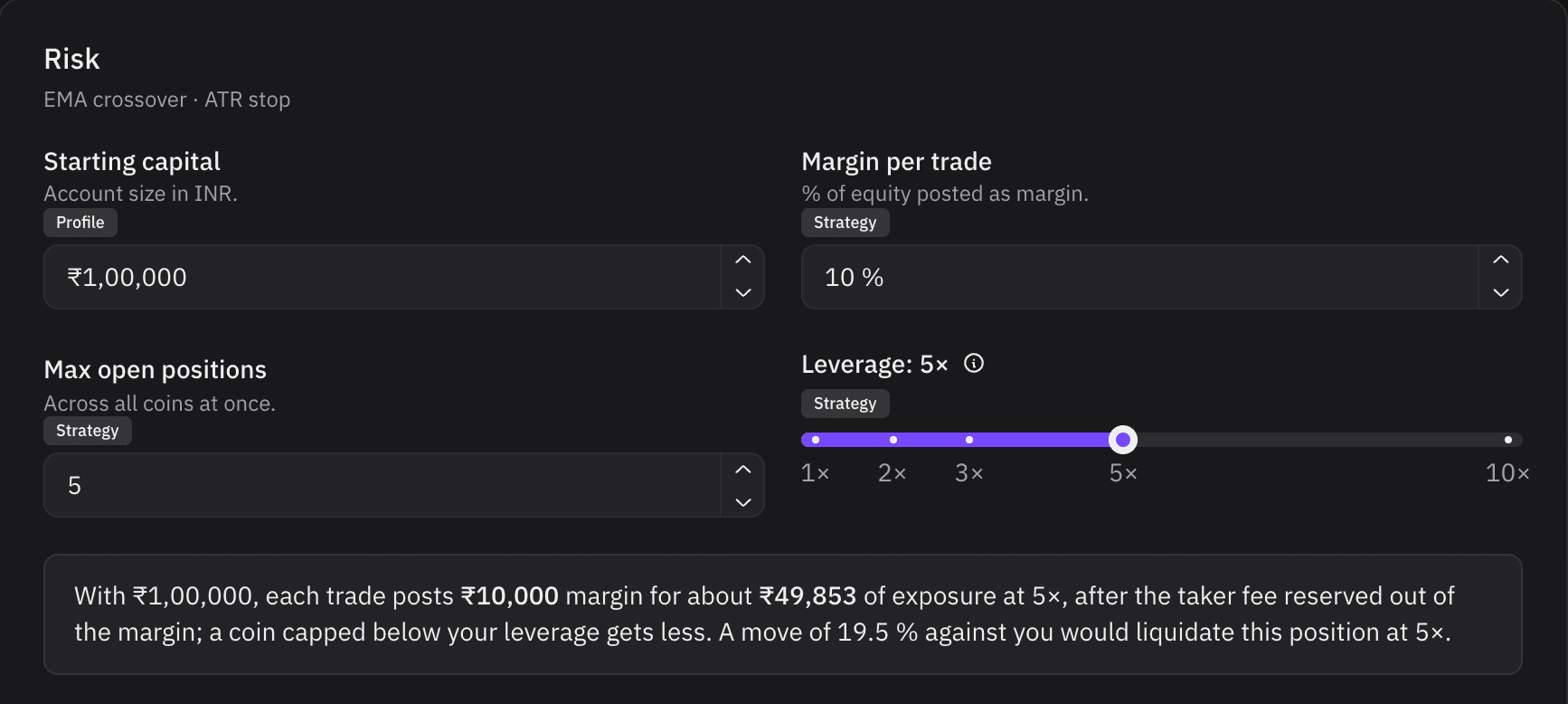
On an isolated position, the move that liquidates it is roughly 100 divided by the leverage, minus the maintenance margin: 0.5% of notional by default. At 20× that is 4.5%; at 5×, 19.5%.
The run form says it beside the leverage field, so the figure is in front of you while you choose.
4.5%against you wipes the margin
A move of 4.5 % against you would liquidate this position at 20×.
The guard refuses this run. Your 5 % stop is at or beyond that price: the position is liquidated first and loses its whole margin, so the stop never fills.
Isolated margin, 0.5% maintenance, the Lab's default. The | in the meter is your stop.
What the backtest models
- Liquidation
- For isolated and cross margin, inside the simulation: a liquidated position ends, and its loss counts.
- Per-coin leverage caps
- Each coin trades at the lower of your leverage and its own cap. Backtests accept up to 125×; deployments up to 100×.
- The liquidation guard
- A stop-loss at or beyond the liquidation price is refused with an explanation, because it could never trigger. You can acknowledge it and run anyway.
- The leverage audit
- Every report lists which caps applied, to which coins, and where they came from.
- Research runs
- A what-if with caps ignored is labelled research, and a strategy tested that way cannot be deployed.
What this does not do
The Lab models liquidation from an execution profile's maintenance margin and rules. A real exchange account can differ in the details, such as tiered margin or auto-deleveraging in extreme markets. Trading leveraged derivatives can lose more than you expect, including the whole margin. This is software, not advice, and a good backtest is not a promise.
Read the long version in leverage and liquidation, explained.
Leverage questions
What leverage should I use?
What does the liquidation guard refuse?
Does it model cross margin?
Opens 1 December 2026, 00:00 IST: get in first
- 500 launch credits, added to your account when paid plans open.
- Early access by invitation, about a week before launch.
- First month of a higher plan at the Starter price.
The terms
The benefits attach when you create your account with the same email address and phone number you used on the waitlist and verify both. Joining the waitlist after launch gives no founding benefits.
Updated . Read this page as Markdown. Trading leveraged crypto derivatives can lose more than your margin; nothing here is investment advice.